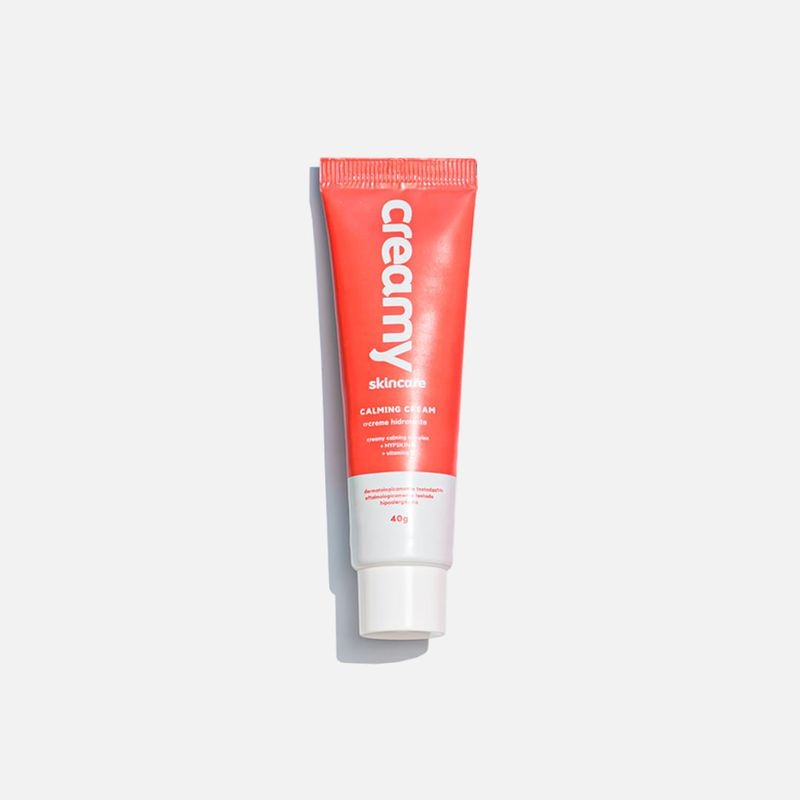
What Creamy’s Calming Cream actually is: a facial moisturiser with a light gel-cream texture, a fragrance-free positioning and a formula that is more than one headline ingredient.
A moisturiser, not a cleanser or an exfoliating serum
Calming Cream is a specific facial moisturiser from Brazilian skincare brand Creamy. The official page calls it a soothing gel-cream and positions it around light hydration and comfort. That is a more precise description than treating every item sold by Creamy as an acid serum. The product name includes Cream, but the brand describes the texture as a fluid gel-cream rather than a dense balm.
The distinction matters when organising a routine. A cleanser removes what needs washing away; this product belongs to moisturising care. It is not a sunscreen and should not be counted as one, and it is not presented here as an exfoliant. Its job in this article is deliberately kept separate from the other product categories shown elsewhere on the brand’s site.
What the gel-cream description tells you
Creamy emphasises a lightweight, fast-absorbing texture and a non-oily finish. Those are the manufacturer’s descriptions, not results of a wear test by this site. The useful expectation is a product intended to spread more lightly than a heavy ointment; it is not a promise that every person will perceive the same finish in every climate or alongside every other product.
If you are comparing it with an existing moisturiser, ask what you want to change: a rich surface feel, the amount of product needed to spread, or the way it sits under your usual daytime products. The words gel, lotion and cream alone do not provide a complete formula comparison. Calming Cream is a useful example of a product whose full positioning is more informative than the last word of its name.
What is actually listed in the formula?
The published ingredient list includes water, cyclopentasiloxane, cetearyl olivate, sorbitan olivate, propanediol, bisabolol, tocopheryl acetate, glycerin and several botanical or marine-derived ingredients. Mentioning these is a way to identify the product, not a calculation of how much of each ingredient is present. The page does not supply a percentage for every component, so this guide does not invent one.
Creamy highlights its Calming Complex and Hypskin alongside vitamin E and alpha-bisabolol. These highlighted names should be read together with the complete ingredient list rather than as a substitute for it. Hypskin is a branded ingredient designation, not proof that every product containing a marine extract is the same formula. Likewise, a familiar ingredient name does not make two finished moisturisers interchangeable.
Fragrance-free and the intended audience
The official page identifies the formula as fragrance-free and positions it especially for sensitive or temporarily sensitised skin, while also saying it can serve other skin types that want light hydration. This is the brand’s stated audience. It does not establish that every user will tolerate the product or that all products in Creamy’s wider range have the same fragrance policy.
The page also uses the term hypoallergenic. That is not a reason to ignore an ingredient you already know you cannot use. For a useful comparison, retain the exact product name and check the current packaging instead of extending claims from Calming Cream to a different Creamy moisturiser. Personal tolerance and the feel of a finished formula cannot be established by the tube colour.
How to think about its place in a routine
Classify Calming Cream as the moisturising part of a routine, distinct from cleansing and any separately selected products. Use the directions on the current packaging for application, quantity and frequency; the material reviewed here does not justify inventing a universal number of pumps or a fixed waiting interval between layers. Keeping those limits explicit is better than supplying a precise-looking but unsupported method.
Creamy discusses the product alongside routines involving acids, and the page offers bundles with other products. A bundle does not mean every combination is required, or that this moisturiser makes every active product appropriate for everyone. This guide is describing the product’s role, not prescribing an acid routine or suggesting that a cosmetic should replace professional care for a persistent skin problem.
What the official results do and do not mean
The product page presents percentage-based user results after a stated study period. These are brand-reported outcomes, not independent measurements performed for this article. They should not be turned into a promise that a new user will have the same experience. An informative product description separates what the manufacturer reports from what this site has actually tested.
The same applies to immediate-comfort language: it is part of the official product positioning, not a guaranteed outcome. For a straightforward decision, compare the product type, full formula, fragrance-free statement and intended texture first. These identify what is being offered without converting a marketing result into a medical claim.
Questions about the name and the format
Is Calming Cream a heavy cream? The name alone suggests little; Creamy describes this particular product as a light gel-cream. Is it an acid treatment? It is presented as a moisturiser, not the same category as the brand’s acid products. Is it just vitamin E? No: vitamin E is one highlighted element of a broader finished formula.
Does a matching bundle make every step necessary? No: read each item’s purpose separately. Does fragrance-free mean universally suitable? No individual guarantee follows from that label. The clearest summary is that Calming Cream is a specifically identified facial gel-cream moisturiser with a lightweight, fragrance-free positioning—not a generic stand-in for every skincare product sold by Creamy.